Thursday, November 4, 2010

Burnished Clay Pots

Mexico By Hand is excited to be exhibiting the beautiful clay pots from Huancito, Michoacán at the Green Festival on Nov. 6th and 7th in San Francisco.
The first time we went to Huancito (pronounced wáhn-see-toe) was in 2004 to tape an interview with Bernardina Rivera and Elena Felix for our video project for Michoacán's La Casa de las Artesanias, and we really weren't sure what to expect. We found some major challenges taping that day, but the best part was when Elena and Bernardina took us out to where they mine the clay, which was very cool. The women do it all, including picking and digging up the clay and hauling it back home-- all with babies on their backs. At that time we had no idea that these two women who are sisters-in-laws, were in the Banamex collection, Great Masters of Mexican Folk Art. We were grateful for the opportunity to get to meet these very talented women from whom we have been buying for several years now.

We have had funny chance meetings with members of the family since then. I found the beautiful large white pot below when Imelda, Elena's daughter, was holding it on her lap on a sidewalk in Patzcuaro...waiting for a buyer. I had bought several smaller ones from her the year before as she was walking around town with her little brother, carrying a load of pots strapped to her back. It's about a two hour bus ride from Huancito to Patzcuaro; that's what these folks have to do in order to sell their work.
The pots were originally designed thousands of years ago to store water and were stacked as towers because of limited space. After the pieces are formed and air-dried, they are coated with charanda, a soil pigment. They are then burnished or polished with a stone and decorated totally free hand with a squirrel hair brush. They say that the paint is made from ant excrement, but we never got to see them make that.
(left) Imelda is painting pots with her grandmother in the family workshop...

And one Saturday afternoon this past August we ran into Elena Felix sitting on a sidewalk with her pots near the Plaza Grande in Patzcuaro. She had so many beautiful pieces there, including these below, but few takers. There aren't many foreign tourists in Michoacán these days, and unfortunately few Mexican nationals buy elaborate fine quality crafts like these.

It was a good day for Elena and her family, and a great day for Mexico By Hand to be able to purchase this magnificent work that is so appreciated by our customers.

I've also gotten to know another Huancito family-- the Espicios. They have visited me bearing pots at my favorite Patzcuaro hotel, Meson de San Antonio, and this summer we happened to be driving off at just the right time when we saw Marta (below on left) walking up the hill to our hotel with some gorgeous pots to show me. Her husband, David, and their children all work with clay. The two pots with handles (photo above) are part of a tower of 8 pieces made by Maria Guadalupe. Mexico By Hand will have work by both Huancito families in booth #534 at the S.F. Green Festival.
For more info. on purchasing these pots, go to www.mexicobyhand.com.

Sunday, October 17, 2010

Sustainable Hammered Copper


Several hundred people work as copper artisans in the small town of Santa Clara del Cobre in Michoacán, Mexico and are recognized throughout the world for their talent and skill.
Hammered copper art from Mexico is not only considered to be the finest in the world, but this traditional Pre-Columbian craft is sustainably produced as well.
Each copper piece is made from 100% recycled copper, eliminating the use of mined resources, and benefiting the environment. The copper is heated in a bonfire made with pine wood scraps. The flame, ash and soot from this process produces the rich chestnut patina. No chemicals are used to achieve this patina, and no molds are used. The artists individually craft each piece by hand, hammered from a single lump of copper-- that was created by melting down the pipe, wire, old motor or cooking pot. The process is extremely laborious, in many case requiring a full month or more of daily work, which consists of repeated heating and hammering the raw copper first into a mass, and then into the desired shape, finally ending with the process of a beautiful hammered finish. The work requires not only skill, but great strength and endurance, as it may take thousands of hammer blows in order to complete one large piece. Every piece is made entirely by hand and no two are exactly alike. Mexico By Hand is proud to feature the copper art created by Roberto Castro Hernandez (below).

We'll be selling hammered copper and other beautiful handmade sustainable art from Michoacán, Mexico at the San Francisco Green Festival the weekend of November 6th & 7th. Come visit us! We'll be in the Fair Trade section in booth 534. http://www.greenfestivals.org
To make a purchase or for more information, you can also find us at www.mexicobyhand.com.


Tuesday, September 28, 2010

Adelitas

"La Adelita" in Mexico has become an archetype of a woman warrior during the Mexican Revolution. An Adelita was a soldadera, or woman soldier, who not onlycooked and cared for the wounded but also actually fought in battles against Mexican government forces. In time the word “Adelita” was used for all the soldaderas, who became a vital force in the revolutionary war efforts.


The pictures above and on the left are examples of popular Mexican images of a sexy Adelita.

Today the term and image has evolved, and "Adelita" is used to signify a woman of great strength and courage.


Mexico By Hand salutes the Adelitas of the Mexican Revolution of 1910, as well as the millions of modern day Adelitas who also exhibit great strength and courage.

Que viva Mexico! Que vivan las Adelitas!
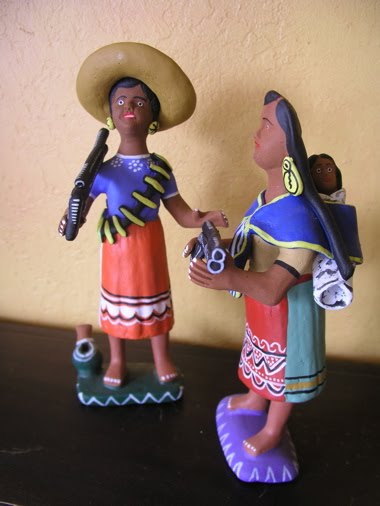
Here are some contemporary clay figures made by the award-winning Purepecha artist, Zenaida Rafael Julian of the village of Ocumicho.
Below, Zenaida's Adelita is riding along side a male revolutionary. The other Adelita's are armed indigenous women who often carried their babies wrapped in a rebozo on their backs.


These and other Adelita figures are available through: www.mexicobyhand.com. Please contact us for more information.

Monday, July 26, 2010

Master Artisans ...victims of our ignorance

This is not an unusual scene here in Michoacán, me crouching before an artisan and her wares. What is remarkable about this picture is the artisan who is sitting on the cold stones steps of a doorway with her children hovering nearby. This is Elena Felipe Felix, an award-winning artist who is featured in the prestigious book and collection, Masters of Mexican Folk Art. We met Elena six years ago when we filmed her in her family workshop in the remote pueblo of Huancito for our video documentary. Since then her work has been selling well in the U.S. and some of her pieces are part of the permanent collection of Mexico's Museum of Arte Popular. (See my previous post with more info. on Elena and her sister-in-law: http://mexicobyhand.blogspot.com/2009/11/huancito-clay-pots.)
On this Saturday Elena and her children traveled two hours by bus from her village, her clay pots wrapped in a rebozo on her back, in order to sell her work to passersby near the Plaza Grande in Patzcuaro. I was happy to see her of course, because I was anxious to buy her beautiful work again. And the feeling was mutual, because she needed the sale. A few people stopped to look as I was selecting my pieces for purchase (it seems to attract Mexican customers when there's a gringo who's interested) but they walked on after asking the price. Without divulging the amount I spent, let's just say the asking price was ridiculously low for the amount of talent and work involved in creating these pieces. Mexican tourists (and there were many in Patzcuaro that day) aren't buying traditional fine crafts, and Americans are too afraid to travel to Mexico. So Elena Felix, like so many other talented master Mexican artists are left to peddle their work on the street, along with the 7 year old child who sells gum, and the 70 year old woman who sells peanuts. Will her children who are watching her struggle choose to continue to work as artesanos like their mother? Or will they be leaving their homes and head for El Norte, as so many from Michoacán have done already? This is not only about the survival of these families, but the survival of an endangered art form.
What can we do? We can buy this beautiful traditional art and enhance our own lives as well.
Burnished pots like these from Elena Felix, plus the video showing her working, will be available for purchase at www.mexicobyhand.com

Monday, June 28, 2010

Santa Fe International Folk Art Market

Getting closer to our departure for the Santa Fe International Folk Art Market. The copper pieces have arrived, after making the long journey from Santa Clara del Cobre, but unfortunately their creator, Roberto Castro Hernandez, won't be joining them. Roberto told me that personal financial issues prevent him from traveling to Santa Fe, and the fact that our U.S. State Dept. makes it SO damn difficult for Mexicans to get a tourist visa was extremely discouraging. Presenting an official letter of invitation from the New Mexican government, explaining that Roberto was selected to exhibit at this prestigious cultural event made no difference...they wouldn't give him permission to spend four days in this country. No wonder people give up trying to come here legally-- it's almost impossible to get a visa!


Hopefully we will have great success, sell it all for him, and will work on bringing Roberto next year. Here are samples of two pieces that have been favorites in past years.

But...Felipe Horta, talented mask maker from Tocuaro, Michoacán, will be with us in our booth!

If you want to learn more about the fabulous Santa Fe International Folk Art Market, coming this July 9-11, check out their website: www.folkartmarket.org

Wednesday, May 5, 2010

Cinco de Mayo


It's Cinco de Mayo and I am aware--again-- of how little we Americans really know about our neighbor to the south. So, let's get this out of the way. Yes, it's a cool holiday for those of us who like to drink margaritas and Coronas and have a good time celebrating the color and spirit of Mexico. But, it's not Mexican Independence Day. Cinco de Mayo is not even celebrated in most parts of Mexico. I remember when we were living in Morelia in May of 2004, and I was shocked that NOTHING was happening! Just a regular day, it wasn't even a day off from school. If you want to celebrate, go ahead, because though it's not significant for the Mexicanos in Mexico, it is a big day for Latino pride here in the U.S. You might want to read the link below to find out what did happen on the 5th of May in 1862.
http://www.mexonline.com/cinco-de-mayo.htm
Oh, and maybe this year you should do something different. Like try drinking a good Mexican beer such as Bohemia. By the way, if you are ever in Michoacan, la cerveza Victoria is mighty tasty.
But if you really want to celebrate, buy a nice piece of art-- such as the Virgen of Guadalupe figure above from Ocumicho, or a handmade rebozo or blouse. It will help a struggling Mexican artist, and bring some beauty into your life that will last a lot longer than your tequila buzz.
For a large selection of fine Mexican folk art and crafts go to www.mexicobyhand.com
(below on left) Rebozo from La Piedad. Many other styles and colors also available.
(below on right) Handpainted batea from Quiroga.

Sunday, April 25, 2010

Calabacitas-- Burnished Clay Squash

Since we started Mexico By Hand, the burnished clay squash have always been a special item for our customers. In 2005, the first year we exhibited at the Santa Fe International Folk Art Market, we had 25 of them-- and sold out in two days. They reflect a love of nature, create a warmth in one's home, and of course are beautiful to the eye. Many people, including me, enjoy stroking them as well, as they are so smooth and sensuous. Really they are.

The Martinez family has one of the three workshops on the same short block in Zinapecuaro, Michoacán-- where the calabazas or burnished squash are made. We had been buying from the other two artisan families for many years now, but a couple of years ago we discovered the Martinez family -- dad, mom and son-- thanks to this boy here, who is NOT a member of the family. On one of our annual trips to the town, this guy came out to hustle us inside, as he saw us going into his neighbor's place, our friends the Hernandez Cano family, to buy clay squash. In other words, he was trying to steer us away from the competition. We agreed to come by afterwards, and we did. The mini squash are a new thing in town, and the Señora's specialty. Her husband, Ventura Martinez and their son, Fernando, make the large ones. The chico spends a lot of time helping the Señora, instead of going to school because he says it doesn't interest him. She in turn feeds him and basically mothers him, something he apparently doesn't get much of in his own family. I hope the boy listens to my advice about the importance of knowing how to read and do math if you're going to be a successful artisan. Obviously he finds something interesting and worth learning in this family's clay workshop. Who knows, maybe I'll buy one of his creations someday if he sticks with it and learns the craft.


 These beautiful  burnished squash come in a variety of sizes and colors and are available at the Mexican Museum store in San Francisco www.mexicanmuseum.org and on our website: www.mexicobyhand.com. Please contact us at (510) 526-6395 for more info. if you'd like to order.