Sunday, February 13, 2011

In Celebration of the Olmecs

I've written about the Hernandez Cano workshop several times before. They have been a favorite of ours for a long time, and it's great that these artisans are finally being recognized by others for their unique, beautiful burnished pottery featuring Pre-Columbian designs. Numerous of their pieces are now on display in the museum store of the de Young Museum in San Francisco-- to coincide with the upcoming Olmec exhibit.
The Olmecs are most known for the their colossal stone heads and were considered to be the mother culture of Mesoamerica. This artisan workshop, located in Zinapecuaro, Michoacán, specializes in replicating an ancient pottery technique and Pre- Columbian designs. The photo above was taken at the workshop when we picked up the museum's order. Several pieces shown here are part of the stunning collection currently on sale at the de Young. The guys did their best work for this San Francisco show, and we are so pleased to be able to share it with folks in the Bay Area who appreciate fine Mexican crafts.
I love the creativity of this family, and how they all work together, with the younger generation now taking more of a role in both creating new designs and managing the business. I'll never forget my surprise when my first big order in 2005 was written down with pencil on notebook paper. They still use spiral notebooks, but now I am able to place orders via email with Salvador Hernandez Cano's son, German. I am happy to see this technology come to rural Mexico, and thankful that their friendly, honest way of doing business has not changed one bit.


Salvador Hernandez Cano of Zinapecuaro.


If you're interested in seeing more of the burnished pottery from the Hernandez Cano family workshop, please contact Mexico By Hand at: www.mexicobyhand.com or call (510)526-6395

And check out our other blog posts on ceramics with Pre-Columbian designs.


Thursday, November 18, 2010

Lead-Free Clay Cookware


"You can put them on the stove??" is a frequent question from many people when they see this clay cookware. No offense intended, but that's like asking a salesperson if you can wear a raincoat in the rain. Umm...that's what they're for.
Es para cocinar. Or to translate into English, "It's for cooking". The amazing thing about these casseroles and pots (and the molera above) is not that you can put them directly on a gas flame or wood fire-- or inside the oven--but that they're from Mexico, and they are LEAD FREE. Most Americans don't realize that even though it has been the law for several years that all pottery designed for food use must be lead free, what you usually get in Mexico-- still-- has lead in the glaze. So most likely the stuff sold as "vintage" collectibles on eBay is full of lead, as is most of the cheap pottery sold in the markets all around Mexico. However this pottery, which is exported by a non-profit organization in Mexico called Barro Sin Plomo, which means lead free clay, is the only Mexican clay cookware imported to the U.S. that is certified lead free.

Using lead free pottery is better for your health, and for the health of the Mexican artisans and their families whose workshops are no longer contaminated with lead dust. The earnings from the pottery sales provide essential economic support for families in several poor Mexican communities, and are also used in the campaign to encourage more artisans to give up the use of lead in their clay process.
I mentioned the usual reaction by Americans to this cookware, but there is also a typical response from Mexicanos or Mexican-Americans when they see it here in the United States. Young and old, men and women, most react emotionally, remembering an
abuelita who used to cook amazing sopa, frijoles, or mole in simple pots just like these. They know that the food tastes better cooked in clay-- no convincing needed there. This is part of their cultura, and the memories and feelings are strong. So many of these folks, while they have adapted to the American style of supermarket shopping and food preparation, remember a time when there was always a pot of something delicious on the fire, cooking nice and slow, all day long.
The family's meal was
homemade, and the clay pot used for cooking it was handmade... like this one on the right, which is part of our new product line we're calling Cocina Sana (healthy kitchen) through Mexico By Hand.
For more information, or to purchase lead-free clay cookware, please go to www.mexicobyhand.com
or contact us at: (510) 526-6395.
Wholesale customers of Cocina Sana are most welcome.


See traditional clay cookware being used today in Mexico in the beautiful video below from UNESCO.

Thursday, November 4, 2010

Burnished Clay Pots

Mexico By Hand is excited to be exhibiting the beautiful clay pots from Huancito, Michoacán at the Green Festival on Nov. 6th and 7th in San Francisco.
The first time we went to Huancito (pronounced wáhn-see-toe) was in 2004 to tape an interview with Bernardina Rivera and Elena Felix for our video project for Michoacán's La Casa de las Artesanias, and we really weren't sure what to expect. We found some major challenges taping that day, but the best part was when Elena and Bernardina took us out to where they mine the clay, which was very cool. The women do it all, including picking and digging up the clay and hauling it back home-- all with babies on their backs. At that time we had no idea that these two women who are sisters-in-laws, were in the Banamex collection, Great Masters of Mexican Folk Art. We were grateful for the opportunity to get to meet these very talented women from whom we have been buying for several years now.

We have had funny chance meetings with members of the family since then. I found the beautiful large white pot below when Imelda, Elena's daughter, was holding it on her lap on a sidewalk in Patzcuaro...waiting for a buyer. I had bought several smaller ones from her the year before as she was walking around town with her little brother, carrying a load of pots strapped to her back. It's about a two hour bus ride from Huancito to Patzcuaro; that's what these folks have to do in order to sell their work.
The pots were originally designed thousands of years ago to store water and were stacked as towers because of limited space. After the pieces are formed and air-dried, they are coated with charanda, a soil pigment. They are then burnished or polished with a stone and decorated totally free hand with a squirrel hair brush. They say that the paint is made from ant excrement, but we never got to see them make that.
(left) Imelda is painting pots with her grandmother in the family workshop...

And one Saturday afternoon this past August we ran into Elena Felix sitting on a sidewalk with her pots near the Plaza Grande in Patzcuaro. She had so many beautiful pieces there, including these below, but few takers. There aren't many foreign tourists in Michoacán these days, and unfortunately few Mexican nationals buy elaborate fine quality crafts like these.

It was a good day for Elena and her family, and a great day for Mexico By Hand to be able to purchase this magnificent work that is so appreciated by our customers.

I've also gotten to know another Huancito family-- the Espicios. They have visited me bearing pots at my favorite Patzcuaro hotel, Meson de San Antonio, and this summer we happened to be driving off at just the right time when we saw Marta (below on left) walking up the hill to our hotel with some gorgeous pots to show me. Her husband, David, and their children all work with clay. The two pots with handles (photo above) are part of a tower of 8 pieces made by Maria Guadalupe. Mexico By Hand will have work by both Huancito families in booth #534 at the S.F. Green Festival.
For more info. on purchasing these pots, go to www.mexicobyhand.com.

Sunday, October 17, 2010

Sustainable Hammered Copper


Several hundred people work as copper artisans in the small town of Santa Clara del Cobre in Michoacán, Mexico and are recognized throughout the world for their talent and skill.
Hammered copper art from Mexico is not only considered to be the finest in the world, but this traditional Pre-Columbian craft is sustainably produced as well.
Each copper piece is made from 100% recycled copper, eliminating the use of mined resources, and benefiting the environment. The copper is heated in a bonfire made with pine wood scraps. The flame, ash and soot from this process produces the rich chestnut patina. No chemicals are used to achieve this patina, and no molds are used. The artists individually craft each piece by hand, hammered from a single lump of copper-- that was created by melting down the pipe, wire, old motor or cooking pot. The process is extremely laborious, in many case requiring a full month or more of daily work, which consists of repeated heating and hammering the raw copper first into a mass, and then into the desired shape, finally ending with the process of a beautiful hammered finish. The work requires not only skill, but great strength and endurance, as it may take thousands of hammer blows in order to complete one large piece. Every piece is made entirely by hand and no two are exactly alike. Mexico By Hand is proud to feature the copper art created by Roberto Castro Hernandez (below).

We'll be selling hammered copper and other beautiful handmade sustainable art from Michoacán, Mexico at the San Francisco Green Festival the weekend of November 6th & 7th. Come visit us! We'll be in the Fair Trade section in booth 534. http://www.greenfestivals.org
To make a purchase or for more information, you can also find us at www.mexicobyhand.com.


Tuesday, September 28, 2010

Adelitas

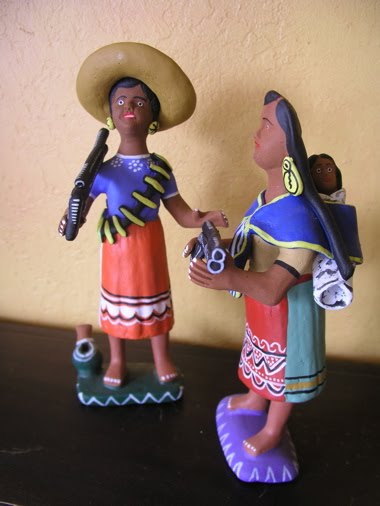
"La Adelita" in Mexico has become an archetype of a woman warrior during the Mexican Revolution. An Adelita was a soldadera, or woman soldier, who not onlycooked and cared for the wounded but also actually fought in battles against Mexican government forces. In time the word “Adelita” was used for all the soldaderas, who became a vital force in the revolutionary war efforts.


The pictures above and on the left are examples of popular Mexican images of a sexy Adelita.

Today the term and image has evolved, and "Adelita" is used to signify a woman of great strength and courage.


Mexico By Hand salutes the Adelitas of the Mexican Revolution of 1910, as well as the millions of modern day Adelitas who also exhibit great strength and courage.

Que viva Mexico! Que vivan las Adelitas!
Here are some contemporary clay figures made by the award-winning Purepecha artist, Zenaida Rafael Julian of the village of Ocumicho.
Below, Zenaida's Adelita is riding along side a male revolutionary. The other Adelita's are armed indigenous women who often carried their babies wrapped in a rebozo on their backs.


These and other Adelita figures are available through: www.mexicobyhand.com. Please contact us for more information.

Monday, July 26, 2010

Master Artisans ...victims of our ignorance

This is not an unusual scene here in Michoacán, me crouching before an artisan and her wares. What is remarkable about this picture is the artisan who is sitting on the cold stones steps of a doorway with her children hovering nearby. This is Elena Felipe Felix, an award-winning artist who is featured in the prestigious book and collection, Masters of Mexican Folk Art. We met Elena six years ago when we filmed her in her family workshop in the remote pueblo of Huancito for our video documentary. Since then her work has been selling well in the U.S. and some of her pieces are part of the permanent collection of Mexico's Museum of Arte Popular. (See my previous post with more info. on Elena and her sister-in-law: http://mexicobyhand.blogspot.com/2009/11/huancito-clay-pots.)
On this Saturday Elena and her children traveled two hours by bus from her village, her clay pots wrapped in a rebozo on her back, in order to sell her work to passersby near the Plaza Grande in Patzcuaro. I was happy to see her of course, because I was anxious to buy her beautiful work again. And the feeling was mutual, because she needed the sale. A few people stopped to look as I was selecting my pieces for purchase (it seems to attract Mexican customers when there's a gringo who's interested) but they walked on after asking the price. Without divulging the amount I spent, let's just say the asking price was ridiculously low for the amount of talent and work involved in creating these pieces. Mexican tourists (and there were many in Patzcuaro that day) aren't buying traditional fine crafts, and Americans are too afraid to travel to Mexico. So Elena Felix, like so many other talented master Mexican artists are left to peddle their work on the street, along with the 7 year old child who sells gum, and the 70 year old woman who sells peanuts. Will her children who are watching her struggle choose to continue to work as artesanos like their mother? Or will they be leaving their homes and head for El Norte, as so many from Michoacán have done already? This is not only about the survival of these families, but the survival of an endangered art form.
What can we do? We can buy this beautiful traditional art and enhance our own lives as well.
Burnished pots like these from Elena Felix, plus the video showing her working, will be available for purchase at www.mexicobyhand.com

Monday, June 28, 2010

Santa Fe International Folk Art Market

Getting closer to our departure for the Santa Fe International Folk Art Market. The copper pieces have arrived, after making the long journey from Santa Clara del Cobre, but unfortunately their creator, Roberto Castro Hernandez, won't be joining them. Roberto told me that personal financial issues prevent him from traveling to Santa Fe, and the fact that our U.S. State Dept. makes it SO damn difficult for Mexicans to get a tourist visa was extremely discouraging. Presenting an official letter of invitation from the New Mexican government, explaining that Roberto was selected to exhibit at this prestigious cultural event made no difference...they wouldn't give him permission to spend four days in this country. No wonder people give up trying to come here legally-- it's almost impossible to get a visa!


Hopefully we will have great success, sell it all for him, and will work on bringing Roberto next year. Here are samples of two pieces that have been favorites in past years.

But...Felipe Horta, talented mask maker from Tocuaro, Michoacán, will be with us in our booth!

If you want to learn more about the fabulous Santa Fe International Folk Art Market, coming this July 9-11, check out their website: www.folkartmarket.org